CUDA Perceptron in 2008
CUDA Perceptron in 2008
After I finished by B.S. in Computer Engineering, my thought was to take a quick two year extension into a Masters degree, just for pure marketability before getting into the job market. I hadn’t yet gotten the itch for research, and I wasn’t keenly invested into the state of machine learning at the time. However, I had previously run projects for both image classification using neural-networks, and as a side-project, a friend and I attempted to train an NN for stock prediction – a hopeless task, but at least one which was pretty educational.
Further, because of my original intent in pursuing game-engine architecture, I had spent some time studying both OpenGL, and had become familiar with the concept of general-purpose GPU computing. This was novel at the time – ATI and Nvidia had made these great machines for running graphics pipelines, but their other purposes had only just started to hit the scientific computing scene.
HPC researchers were at the time writing custom graphics code to render bizzaro images as a way to hack their general programs into GPUs. Nvidia, in a stroke of brilliance, capitalized on this growing niche with the release of CUDA in 2006. CUDA made the implementation of such general algorithms so much smoother, and started the march of tooling that arrived at the general state of AI computing today.
I wanted to wed together these two interests, so in 2007-2008 I sought to write neural-network computations on the GPU. Initially I didn’t have a concept for implementing the efficient training of NNs, however my first pass was focused on accelerating inference on MLPs. However, I believe one of the first references was Oh & Jung’s 2004 publication GPU Implementation of Neural Networks for text classification. Like my own junior effort, this paper nowhere describes how to train such a network, but the promise was certainly there.
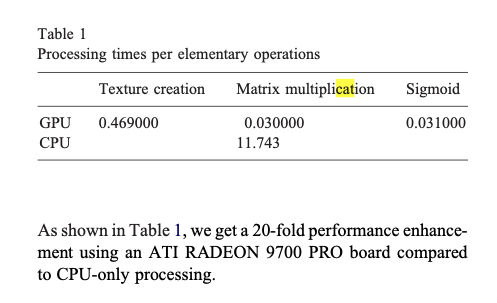
Later, and more notably, Ng and students published on efficient DBN training on GPU in 2009. But I think maybe the prize goes to Chellapilla, Puri, and Simard with their 2006 work High Performance Convolutional Neural Networks for Document Processing, which implemented both forward and back-prop to permit full CNN training on the GPU to great effect. Perhaps their only sin with respect to the arc of history was to achieve a mere 3x speedup versus the 70x that Raina, Madhavan, and Ng would report a few years later. Perhaps there was a bitter lesson there – Ng et all opted for a then-refined CUDA + GPU setup versus the pixel & vertex shader programming on ATI cards that netted Chellapilla et al such a modest gain.
However, at the time, I was unaware of these developments. As I said, I had no introduction to research practice at this point in 2007-2008. It is now a funny artifact of history that I can see that I had stumbled into a topic that was really bleeding edge, and would later have a huge impact on the world with Krizhevsky, Sutskever, and Hinton’s AlexNet moment in 2012.
While I was able to get running on CUDA and got some nice speedups on MLP inference, I didn’t pursue the topic and dropped it. Why?
Funding. At the time, the professor I was working with offered me no funding whatsoever, and was willing to just take me on as a kind of self-funded student. I had some TA work, but this was a really bad setup for my personal situation. Lack of Mentorship. MSU didn’t really have anyone working on these ML topics or really involved in the community at the time – which is why even if I had continued, I would have missed the entire wave. Having connections within an active area of research is critical, and my impromptu-not-quite-advisee-and-no-funding situation didn’t help. Too Early For Impact. Again, one needs to think about the timing. Speedups end-to-end training speedups on GPU were demonstrated in 2006 and 2009. However, the “AlexNet Moment” didn’t occur until 2012. The reasons for this are probably long, but the main one was that we just did not have access to the kinds of datasets which would permit effective ML training at a useful scale. AlexNet was only possible owing to Fei-Fei Li and the ImageNet dataset. Prior to that, while one could attempt to bring together a lot of data to demonstrate the possibility of training neural networks (e.g. Lecun with MNIST), there was no practical day-to-day utility in it since no organization was undertaking that or had access to such data readily. The world was not yet “ML Ready”. Further, it meant that at the time, there were no public demonstrations of the utility of NNs in the zeitgeist at all – in fact one of my CS professors pointedly told me this field of research was entirely dead.
As further evidence of how early the concept of ML on GPU was at this point, take a look at this April 2008 article on CUDA based on interviews with David Kirk, then Nvidia’s Chief Scientist. While there is a great discussion of the architecture of Nvidia chips, CUDA, and the utility for wide-ranging applications, what isn’t there is a single mention of pattern recognition, machine learning, AI, etc.
Experiments
Doing a bit of self-archaeology, I was able to come up with at least a little bit of information about this project. From the schematic below, it seems like I was taking a look at the implementation of just a single linear layer with an activation function (y = f(W x)).
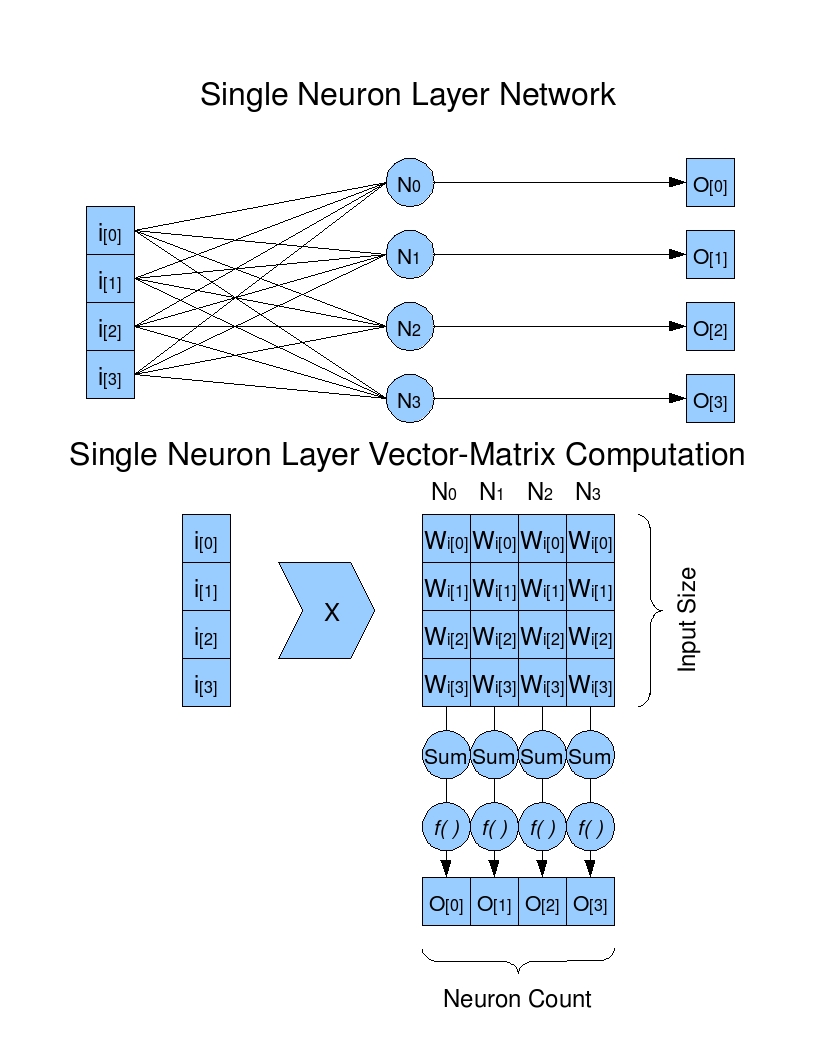
The game of this experiment is to see where the advantage of GPU computation comes in for this simple operation. To test this, it seems like I had three possible options,
**A An 8400GS. This card had 256MB @ ~400Mhz – purportedly able to hit 29.38 GFlops. An 8800 GTS. This card had 320MB @ ~500Mhz, but more parallel compute, clocking in at about 10x the compute throughput, ~228 GFlops.
Scaling up architecture dimensionality, we see an interesting comparison curve.
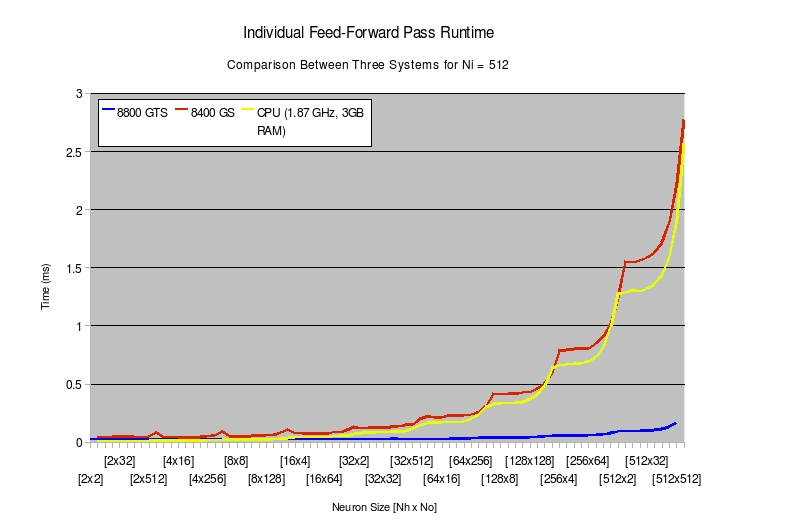
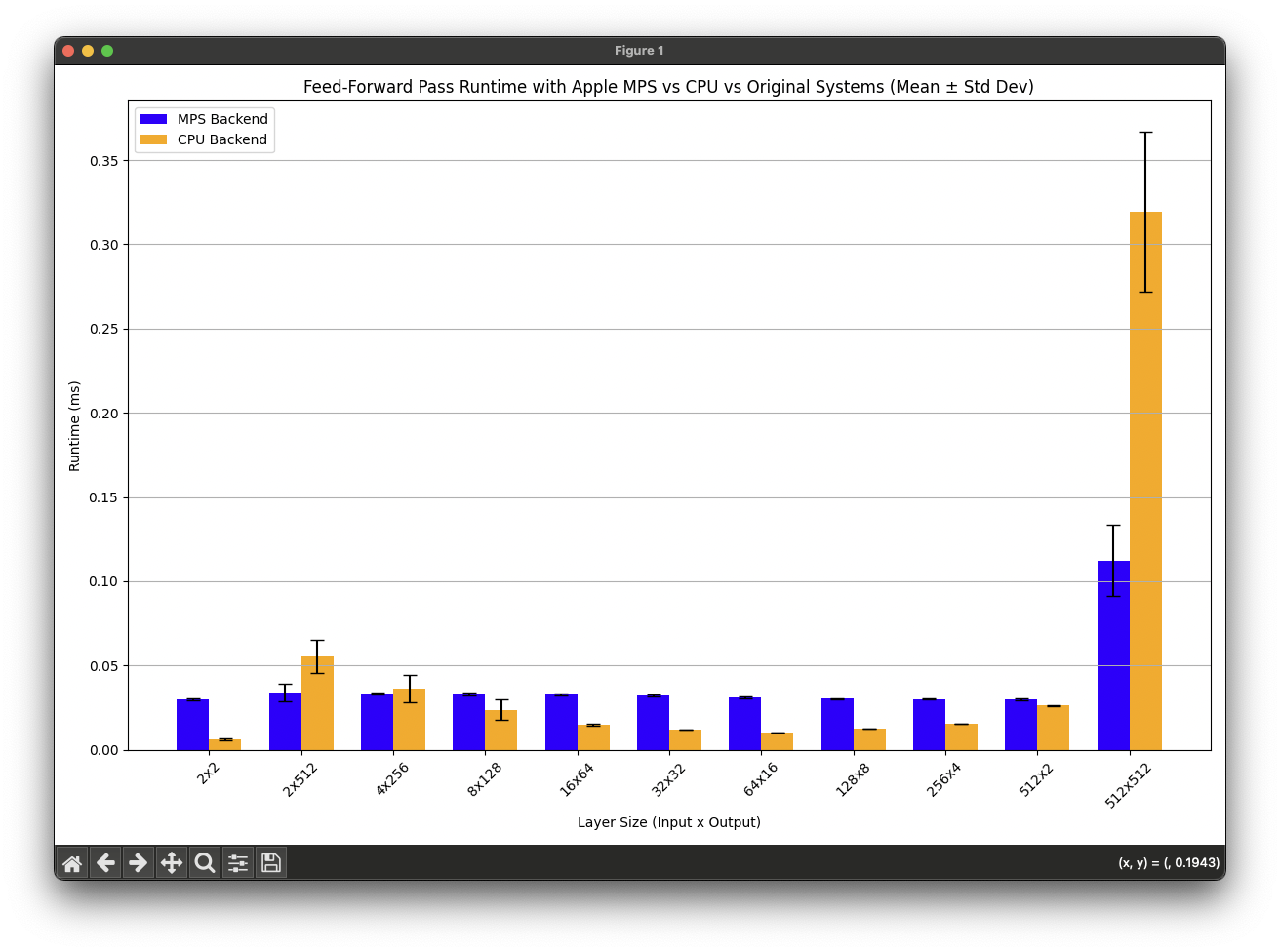
I wanted to understand just how this level of performance compares to today’s consumer hardware. Below, I made a quick comparison for the same experiment, but this time running it on the Apple Silicon M4 chip (a Q4 2024 Macbook). Here, the implementation was done using a simple PyTorch model.
2008 Implementation
For posterity, here you can see what programming NNs looked like at the time and count your blessings.
Main
`1 2 3 4 5 6 7 8 9 10 11 12 13 14 15 16 17 18 19 20 21 22 23 24 25 26 27 28 29 30 31 32 33 34 35 36 37 38 39 40 41 42 43 44 45 46 47 48 49 50 51 52 53 54 55 56 57 58 59 60 61 62 63 64 65 66 67 68 69 70 71 72 73 74 75 76 77 78 79 80 81 82 83 84 85 86 87 88 89 90 91 92 93 94 95 96 97 98 99 100 101 102 103 104 105 106 107 108 109 110 111 112 113 114 115 116 117 118 119 120 121 122 123 124 125 126 127 128 129 130 131 132 133 134 135 136 137 138 139 140 141 142 143 144 145 146 147 148 149 150 151 152 153 154 155 156 157 158 159 160 161 162 163 164 165 166 167 168 169 170 171 172 173 174 175 176 177 178 179 180 181 182 183 184 185 186 187 188 189 190 191 192 193 194 195 196 197 198 199 200 201 202 203 204 205 206 207 208 209 210 211 212 213 214 215 216 217 218 219 220 221 222 223 224 225 226 227 228 229 230 231 232 233 234 235 236 237 238 239 240 241 242 243 244 245 246 247 248 249 250 251 252 253 254 255 256 257 258 259 260 261 262 263 264 265 266 267 268 269 270 271 272 273 274 275 276 277 278 279 280 281 282 283 284 285 286 287 288 289 290 291 292 293 294 295 296 297 298 /*************************************************************************** CUDATest: This application is meant to be a simple test bench to play with kernel code for CUDA.
Author: Eric Tramel, MSU ***************************************************************************/
#include #include #include #include #include #include #include “template_kernel.cu”
//#define PAUSE #define CHECK_OUTPUT
#define NUMBER_RUNS 10 #define PASS_COUNT 300
const int DESIRED_RES = INPUT_COUNT*HIDDEN_LEVEL_NEURON_COUNT; const int hiddenLevelWeightingMatrixSize = INPUT_COUNT * HIDDEN_LEVEL_NEURON_COUNT; const int outputLevelWeightingMatrixSize = HIDDEN_LEVEL_NEURON_COUNT * OUTPUT_LEVEL_NEURON_COUNT;
float minf(float a, float b){ float out = a; if(b a) out = b; return out; }
void displayVector(float* vector, int length){ int i; for(i = 0; i [0],[1],[2],…,[INPUT_COUNT] is the first COLUMN //of our matrix. Immediate after this is the NEXT COLUMN, and so on. // #ifdef PAUSE getchar(); printf(“Initializing Input Vector\n”); #endif for(counter = 0; counter >>(d_inputVector, d_hiddenLevelWeightingMatrix, d_hiddenToOutputBuffer); generalPerceptron>>(d_hiddenToOutputBuffer,d_outputLevelWeightingMatrix,d_outputVector);
//Initialize hTimer
//
cutCreateTimer(&hTimer);
cutResetTimer(hTimer);
cutStartTimer(hTimer);

//Execute the kernel using the data we copied from our host allocated memory into the
//device global memory.
//
#ifdef PAUSE getchar(); printf(“Calling inputToHidden>> -> hiddenToOutput>>\n”); #endif int passCount; for(passCount = 0; passCount >>(d_inputVector, d_hiddenLevelWeightingMatrix, d_hiddenToOutputBuffer); generalPerceptron>>(d_hiddenToOutputBuffer,d_outputLevelWeightingMatrix,d_outputVector); }
//CUT_CHECK_ERROR("Execution failed");
cudaThreadSynchronize();
cutStopTimer(hTimer);

//Capture the d_outputVector from the device global memory and then copy it back to
//the Host device, (CPU)
//
//For debug purposes, lets gather together all of our global data out of the device
//
cudaMemcpy(h_hiddenLevelWeightingMatrix,d_hiddenLevelWeightingMatrix,	sizeof(float) * hiddenLevelWeightingMatrixSize, cudaMemcpyDeviceToHost);
cudaMemcpy(h_hiddenToOutputBuffer,		d_hiddenToOutputBuffer,			sizeof(float) * HIDDEN_LEVEL_NEURON_COUNT,		cudaMemcpyDeviceToHost);
cudaMemcpy(h_outputLevelWeightingMatrix,d_outputLevelWeightingMatrix,	sizeof(float) * outputLevelWeightingMatrixSize, cudaMemcpyDeviceToHost);
cudaMemcpy(h_outputVector,				d_outputVector,					sizeof(float) * OUTPUT_LEVEL_NEURON_COUNT, 		cudaMemcpyDeviceToHost);
cudaMemcpy(h_hiddenLevelFinishedFlag,	d_hiddenLevelFinishedFlag,		sizeof(unsigned int),							cudaMemcpyDeviceToHost);

currentTime = cutGetTimerValue(hTimer);
#ifdef CHECK_OUTPUT int j; printf(“[Run %d]: “,runCount); for(j = 0; j `
CUDA Kernels
1
2
3
4
5
6
7
8
9
10
11
12
13
14
15
16
17
18
19
20
21
22
23
24
25
26
27
28
29
30
31
32
33
34
35
36
37
38
39
40
41
42
43
44
45
46
47
48
49
50
51
52
53
54
55
56
57
58
59
60
61
62
63
64
65
66
67
68
69
70
71
72
73
74
75
/*FOUND THE DEADLOCK ERROR:
For the first stage of the neural net, we CANNOT have a __synchthreads() for only
a specific number of threads within a single block: this is going to cause a deadlock
as the other threads are supposed to wait to arrive at a point that they can never
get to (having __syncthreads() within an if(threadIdx) conditional). To overcome this
we're going to have to make the hidden layer matrix conform to our sizing rules (256
threads/column) and simply pad our data.

*/

#define IDENTITY 0
#define SIGMOID  1
#define INPUT_COUNT 64
#define HIDDEN_LEVEL_NEURON_COUNT 256
#define OUTPUT_LEVEL_NEURON_COUNT 32

__device__ float
activationFunction (float in, int mode){
	switch(mode){
		case IDENTITY:
			return in;
		case SIGMOID:
			//This exp function could be potentially taking 32 clock cycles
			//It must be computed once for each neuron.
			//Required, though :/
			//
			return 1/(1 - expf(-1.0*in));
	}

return 0.0;
}

template unsigned int inputCount>
__global__ void
generalPerceptron(float* g_inputVector, float* g_weightingMatrix,
				  float* g_outputVector){
	extern __shared__ float sdata[];
	unsigned int tid = threadIdx.x;
	//This multiplacation of blockIdx.x and blockDim.x could potentially be
	//taking 16 clock cycles instead of 4 clock cycles. That is a significant
	//number of wasted clock cycles over the course of thousands of iterations.
	//Perhaps this time could be reduced through use of the __mul24() function.
	//
	//RESULTS: useage of __mul24() versus a straight multiplcation makes no
	//noticable difference overall. Disappointing.
	unsigned int i = __mul24(blockIdx.x,blockDim.x) + tid;

	sdata[tid] = g_weightingMatrix[i] * g_inputVector[tid];

	__syncthreads();

	if (inputCount >= 512) { if (tid  256) { sdata[tid] += sdata[tid + 256]; } __syncthreads(); }
    if (inputCount >= 256) { if (tid  128) { sdata[tid] += sdata[tid + 128]; } __syncthreads(); }
    if (inputCount >= 128) { if (tid   64) { sdata[tid] += sdata[tid +  64]; } __syncthreads(); }

    if (tid  32)
    {
        if (inputCount >=  64) { sdata[tid] += sdata[tid + 32];}
        if (inputCount >=  32) { sdata[tid] += sdata[tid + 16];}
        if (inputCount >=  16) { sdata[tid] += sdata[tid +  8];}
        if (inputCount >=   8) { sdata[tid] += sdata[tid +  4];}
        if (inputCount >=   4) { sdata[tid] += sdata[tid +  2];}
        if (inputCount >=   2) { sdata[tid] += sdata[tid +  1];}
    }

	__syncthreads();

	if(tid == 0){
		g_outputVector[blockIdx.x] = activationFunction(sdata[0],IDENTITY);
	}
}